TW: Certainly terrorism retains symbolic impacts challenging to define by cold hard numbers. But at some point I would hope Americans could, unlike its MSM media, foil terrorism by not fixating and obsessing about it. This weekend's coverage has been ridiculously overwrought and self-absorbed...as usual. No doubt the coming week will add the spice of partisan demagougery.
From Nate Silver at 538.com:
"...Over the past decade, there have been, by my count, six attempted terrorist incidents on board a commercial airliner than landed in or departed from the United States: the four planes that were hijacked on 9/11, the shoe bomber incident in December 2001, and the NWA flight 253 incident on Christmas.
...Over the past decade, according to BTS, there have been 99,320,309 commercial airline departures that either originated or landed within the United States. Dividing by six, we get one terrorist incident per 16,553,385 departures.
These departures flew a collective 69,415,786,000 miles. That means there has been one terrorist incident per 11,569,297,667 mles flown. This distance is equivalent to 1,459,664 trips around the diameter of the Earth, 24,218 round trips to the Moon, or two round trips to Neptune.
Assuming an average airborne speed of 425 miles per hour, these airplanes were aloft for a total of 163,331,261 hours. Therefore, there has been one terrorist incident per 27,221,877 hours airborne. This can also be expressed as one incident per 1,134,245 days airborne, or one incident per 3,105 years airborne.
There were a total of 674 passengers, not counting crew or the terrorists themselves, on the flights on which these incidents occurred. By contrast, there have been 7,015,630,000 passenger enplanements over the past decade. Therefore, the odds of being on given departure which is the subject of a terrorist incident have been 1 in 10,408,947 over the past decade. By contrast, the odds of being struck by lightning in a given year are about 1 in 500,000. This means that you could board 20 flights per year and still be less likely to be the subject of an attempted terrorist attack than to be struck by lightning..."
http://www.fivethirtyeight.com/2009/12/odds-of-airborne-terror.html
Showing posts with label Nate Silver. Show all posts
Showing posts with label Nate Silver. Show all posts
Monday, December 28, 2009


Wednesday, December 16, 2009
Health Care Pragmatism
TW: One of the reason I like Silver so much is his pragmatism (Ezra Klein is similiar). Without pragmatism nothing gets done in politics, which is the Republican strategy of 24/7 opposition can be effective if getting nothing done is the goal. Some liberal Dems are getting seriously agitated that their dreams of a "pure" health care (and many others) bill is not emerging. It is all about the votes, either you have them or you do not.
From Nate Silver at 538.com:
"1. Over the medium term, how many other opportunities will exist to provide in excess of $100 billion per year in public subsidies to poor and sick people?
2. Would a bill that contained $50 billion in additional subsidies for people making less than 250% of poverty be acceptable?
3. Where is the evidence that the plan, as constructed, would substantially increase insurance industry profit margins, particularly when it is funded in part via a tax on insurers?
4. Why are some of the same people who are criticizing the bill's lack of cost control also criticizing the inclusion of the excise tax, which is one of the few cost control mechanisms to have survived the process?
5. Why are some of the same people who are criticizing the bill's lack of cost control also criticizing the inclusion of the individual mandate, which is key to controlling premiums in the individual market?
6. Would concerns about the political downside to the individual mandate in fact substantially be altered if a public plan were included among the choices? Might not the Republican talking point become: "forcing you to buy government-run insurance?"
7. Roughly how many people would in fact meet ALL of the following criteria: (i) in the individual insurance market, and not eligible for Medicaid or Medicare; (ii) consider the insurance to be a bad deal, even after substantial government subsidies; (iii) are not knowingly gaming the system by waiting to buy insurance until they become sick; (iv) are not exempt from the individual mandate penalty because of low income status or other exemptions carved out by the bill?
8. How many years is it likely to be before Democrats again have (i) at least as many non-Blue Dog seats in the Congress as they do now, and (ii) a President in the White House who would not veto an ambitious health care bill?
9. If the idea is to wait for a complete meltdown of the health care system, how likely is it that our country will respond to such a crisis in a rational fashion? How have we tended to respond to such crises in the past?
10. Where is the evidence that the public option is particularly important to base voters and/or swing voters (rather than activists), as compared with other aspects of health care reform?
11. Would base voters be less likely to turn out in 2010 if no health care plan is passed at all, rather than a reasonable plan without a public option?
12. What is the approximate likelihood that a plan passed through reconciliation would be better, on balance, from a policy perspective, than a bill passed through regular order but without a public option?
13. What is the likely extent of political fallout that might result from an attempt to use the reconciliation process?
14. How certain is it that a plan passed through reconciliation would in fact receive 51 votes (when some Democrats would might have objections to the use of the process)?
15. Are there any compromises or concessions not having to do with the provision of publicly-run health programs that could still be achieved through progressive pressure?
16. What are the chances that improvements can be made around the margins of the plan -- possibly including a public option -- between 2011 and the bill's implementation in 2014?
17. What are the potential upsides and downsides to using the 2010 midterms as a referendum on the public option, with the goal of achieving a 'mandate' for a public option that could be inserted via reconciliation?
18. Was the public option ever an attainable near-term political goal?
19. How many of the arguments that you might be making against the bill would you still be making if a public option were included (but in fact have little to do with the public option)?
20. How many of the arguments that you might be making against the bill are being made out of anger, frustration, or a desire to ring Joe Lieberman by his scruffy, no-good, backstabbing neck?"
http://www.fivethirtyeight.com/2009/12/20-questions-for-bill-killers.html
From Nate Silver at 538.com:
"1. Over the medium term, how many other opportunities will exist to provide in excess of $100 billion per year in public subsidies to poor and sick people?
2. Would a bill that contained $50 billion in additional subsidies for people making less than 250% of poverty be acceptable?
3. Where is the evidence that the plan, as constructed, would substantially increase insurance industry profit margins, particularly when it is funded in part via a tax on insurers?
4. Why are some of the same people who are criticizing the bill's lack of cost control also criticizing the inclusion of the excise tax, which is one of the few cost control mechanisms to have survived the process?
5. Why are some of the same people who are criticizing the bill's lack of cost control also criticizing the inclusion of the individual mandate, which is key to controlling premiums in the individual market?
6. Would concerns about the political downside to the individual mandate in fact substantially be altered if a public plan were included among the choices? Might not the Republican talking point become: "forcing you to buy government-run insurance?"
7. Roughly how many people would in fact meet ALL of the following criteria: (i) in the individual insurance market, and not eligible for Medicaid or Medicare; (ii) consider the insurance to be a bad deal, even after substantial government subsidies; (iii) are not knowingly gaming the system by waiting to buy insurance until they become sick; (iv) are not exempt from the individual mandate penalty because of low income status or other exemptions carved out by the bill?
8. How many years is it likely to be before Democrats again have (i) at least as many non-Blue Dog seats in the Congress as they do now, and (ii) a President in the White House who would not veto an ambitious health care bill?
9. If the idea is to wait for a complete meltdown of the health care system, how likely is it that our country will respond to such a crisis in a rational fashion? How have we tended to respond to such crises in the past?
10. Where is the evidence that the public option is particularly important to base voters and/or swing voters (rather than activists), as compared with other aspects of health care reform?
11. Would base voters be less likely to turn out in 2010 if no health care plan is passed at all, rather than a reasonable plan without a public option?
12. What is the approximate likelihood that a plan passed through reconciliation would be better, on balance, from a policy perspective, than a bill passed through regular order but without a public option?
13. What is the likely extent of political fallout that might result from an attempt to use the reconciliation process?
14. How certain is it that a plan passed through reconciliation would in fact receive 51 votes (when some Democrats would might have objections to the use of the process)?
15. Are there any compromises or concessions not having to do with the provision of publicly-run health programs that could still be achieved through progressive pressure?
16. What are the chances that improvements can be made around the margins of the plan -- possibly including a public option -- between 2011 and the bill's implementation in 2014?
17. What are the potential upsides and downsides to using the 2010 midterms as a referendum on the public option, with the goal of achieving a 'mandate' for a public option that could be inserted via reconciliation?
18. Was the public option ever an attainable near-term political goal?
19. How many of the arguments that you might be making against the bill would you still be making if a public option were included (but in fact have little to do with the public option)?
20. How many of the arguments that you might be making against the bill are being made out of anger, frustration, or a desire to ring Joe Lieberman by his scruffy, no-good, backstabbing neck?"
http://www.fivethirtyeight.com/2009/12/20-questions-for-bill-killers.html
Tuesday, December 8, 2009
We Are Alien Too
TW: Mr. Silver has traveled to Copenhagen this week for the climate summit. His brief observation reminds us the narrow and convoluted prisms through which we view the world and the world views us. Folks look at American somewhat cross-eyed and no doubt marred with bias and disinformation. And the U.S. for better or worse is huge and sufficiently important to receive concentrated attention. Our views of other countries are similarly biased and based upon limited information and further distorted by our attention being diffused across numerous allies, frenemies and foes.
From Nate Silver at 538.com:
"...I did have a good conversation with a couple of Brits while waiting in line for my NGO badge. They were very bright and keyed in -- they run a green taxi company in London -- but I was surprised at how confusing they found American politics to be. How can the Senate require 60 percent to pass something? How can Delaware have as many senators as New York? What's up with the whole electoral college thing? How can Obama go from 70 percent popularity to 50 percent in a half a year? Could Sarah Palin really become President someday? The Guardian, among others, has some very good Washington coverage, but I think there's an opportunity for one of the UK dailies to provide a Washington column that's specifically geared toward a British or European audience: we tend to take for granted how freakin' weird our politics can be to the rest of the world.
http://www.fivethirtyeight.com/2009/12/copenhagen-dispatch.html
From Nate Silver at 538.com:
"...I did have a good conversation with a couple of Brits while waiting in line for my NGO badge. They were very bright and keyed in -- they run a green taxi company in London -- but I was surprised at how confusing they found American politics to be. How can the Senate require 60 percent to pass something? How can Delaware have as many senators as New York? What's up with the whole electoral college thing? How can Obama go from 70 percent popularity to 50 percent in a half a year? Could Sarah Palin really become President someday? The Guardian, among others, has some very good Washington coverage, but I think there's an opportunity for one of the UK dailies to provide a Washington column that's specifically geared toward a British or European audience: we tend to take for granted how freakin' weird our politics can be to the rest of the world.
http://www.fivethirtyeight.com/2009/12/copenhagen-dispatch.html
Monday, November 30, 2009
Totally Agree About...Them
TW: Slow news holiday weekend was ripe for a frenzy over the crashers- of the State dinner and into a hydrant outside his house. Folks can follow what they wish but relative to the State dinner yet another bit of civility and national class suffer a defeat at the hands of the exploiters.
From Tom Schaller at 538.com:
"I am sick to my stomach over That Couple. And now comes news they are peddling their exclusive story to the highest media bidder. Disgusting, but hardly surprising.
I’m not going to use their names because you can be sure that, between giddy calls to their agent and lawyer, they are rushing to their computer every half hour to Google themselves. Who’s talking about us now? What are people saying? Look, another picture of us on the web! We’re more famous than any of our friends—no, all of our friends, combined! Tehehehee—the joke’s on you, America!
No, you’re not famous; you’re infamous. You’re situated squarely at the bottom of an already too-deep and increasingly murky barrel of celebrity culture, celebrity journalism, and (un)reality TV, the depths of which are probably making even Andy Warhol cringe in his grave. I want this to be your fifteenth minute. I want your egg timer to ding now, so you can exit our national discourse as swiftly, completely and permanently as possible.
And, you know what? We can do something about it. We can let the producers of whatever crap program agrees to pay these creepy, pathetic, attention-starved goons for the rights to interview That Couple that not only will we tune out that specific broadcast, but we will tune out that program in the future as well. We can compound the effect by identifying the companies that sponsor the airing of the interview, and boycotting their products or services.
Why? Because there are literally millions of Americans who bust their asses through school and job training, who serve our country in the military in harm’s way, or merely plumb our toilets at home or change our baskets at the office—who, in short, work hard, raise their families and pay their taxes--and do all of that with zero expectation that they should win some version of the public celebrity lottery that suddenly showers them with a degree of fame and fortune that That Couple not merely aspires to, but clearly believe they deserve. When somebody like Captain Sully catapults from nowhere to national stardom--or my fellow Bethlehem Central High School alum Rich Jadick becomes a national hero after re-joining the Marines in his late-30s (and despite having a wife and kids and the chance to make a lot of money safely back in the States) to help the medical Corps revolutionize front-line emergency medical care--at least they earned their fame. And I harbor no complaints about how showmen across the ages—from P.T. Barnum to Muhammad Ali, from Harry Houdini to Madonna—maximized their opportunities in order to achieve greater fame and fortune, because they could boast an underlying talent or social value, and often both.
That Couple offers nothing of the sort. In fact, they offer nothing beyond their naked greed and attention-starved egos. They are private and public leeches..."
http://www.fivethirtyeight.com/2009/11/that-couple.html
From Tom Schaller at 538.com:
"I am sick to my stomach over That Couple. And now comes news they are peddling their exclusive story to the highest media bidder. Disgusting, but hardly surprising.
I’m not going to use their names because you can be sure that, between giddy calls to their agent and lawyer, they are rushing to their computer every half hour to Google themselves. Who’s talking about us now? What are people saying? Look, another picture of us on the web! We’re more famous than any of our friends—no, all of our friends, combined! Tehehehee—the joke’s on you, America!
No, you’re not famous; you’re infamous. You’re situated squarely at the bottom of an already too-deep and increasingly murky barrel of celebrity culture, celebrity journalism, and (un)reality TV, the depths of which are probably making even Andy Warhol cringe in his grave. I want this to be your fifteenth minute. I want your egg timer to ding now, so you can exit our national discourse as swiftly, completely and permanently as possible.
And, you know what? We can do something about it. We can let the producers of whatever crap program agrees to pay these creepy, pathetic, attention-starved goons for the rights to interview That Couple that not only will we tune out that specific broadcast, but we will tune out that program in the future as well. We can compound the effect by identifying the companies that sponsor the airing of the interview, and boycotting their products or services.
Why? Because there are literally millions of Americans who bust their asses through school and job training, who serve our country in the military in harm’s way, or merely plumb our toilets at home or change our baskets at the office—who, in short, work hard, raise their families and pay their taxes--and do all of that with zero expectation that they should win some version of the public celebrity lottery that suddenly showers them with a degree of fame and fortune that That Couple not merely aspires to, but clearly believe they deserve. When somebody like Captain Sully catapults from nowhere to national stardom--or my fellow Bethlehem Central High School alum Rich Jadick becomes a national hero after re-joining the Marines in his late-30s (and despite having a wife and kids and the chance to make a lot of money safely back in the States) to help the medical Corps revolutionize front-line emergency medical care--at least they earned their fame. And I harbor no complaints about how showmen across the ages—from P.T. Barnum to Muhammad Ali, from Harry Houdini to Madonna—maximized their opportunities in order to achieve greater fame and fortune, because they could boast an underlying talent or social value, and often both.
That Couple offers nothing of the sort. In fact, they offer nothing beyond their naked greed and attention-starved egos. They are private and public leeches..."
http://www.fivethirtyeight.com/2009/11/that-couple.html
Wednesday, October 14, 2009
Are the Republicans Stalinists And the Dems Country Clubbers?
TW: Some folks, including many Dems, lament the slow pace of legislation so far with the Dem Congress and POTUS. On occasion the Republican are regarded as more tightly organized. Silver posits there is a price to rigidity- exposing your moderates to either losing their seats or perhaps losing interest in their seats.
Some Dems forget the Blanche Lincolns in Arkansas, Ben Nelsons in Nebraska, Mary Landrieus in Louisiana, Evan Bayhs in Indiana are not running in Massachusetts or Vermont or even California. Personally I like the big tent. And yes herding 40 largely ideologically coherent Republicans (the Maine senators excepted) is much easier than herding 60 somewhat diverse Dems.
From Nate Silver at 538.com:
"Matt Yglesias is impressed that Republicans threatened to block Olympia Snowe's ascension to the top minority post on the Senate Commerce Committee were she to vote for Max Baucus's health care bill in committee...
'It’s also worth being clear on this: The Republicans do this the right way. The Senate Republican caucus is organized, like the House caucuses of both parties, like a partisan political organization whose objective is to advance the shared policy objectives of the party. The Senate Democratic caucus, by contrast, is organized like a fun country club trying to recruit members. Join Team Democrat and Vote However You Want Without Consequence! But it’s no way to get things done.'
I wouldn't dispute that in broad strokes the Republicans have run a tighter ship than the Democrats, particularly in the Senate. But, the ship has also spring a lot of leaks. Consider the fate of the 10 most liberal Republican senators as of the start of George W. Bush's first term:
1. Lincoln Chafee (RI) - lost to Sheldon Whitehouse in 2006
2. Jim Jefforts (VT) -- began to caucus with Democrats on 6/6/2001. Retired in 2008.
3. Arlen Specter (PA) -- switched affiliation to Democratic Party on 4/29/2009.
4. Olympia Snowe (ME) -- voted with Democrats on stimulus; likely to do so on health care and climate bill. Won re-election in 2004.
5. Susan Collins (ME) -- voted with Democrats on stimulus; probably will not do so on health care. Won re-election in 2002 and 2008.
6. John McCain (AZ) -- has since become more conservative. Lost Presidential election in 2008.
7. Gordon Smith (OR) -- lost to Jeff Merkley in 2008.
8. Peter Fitzgerald (IL) -- retired in 2004; seat won by Barack Obama.
9. John Warner (VA) -- retired in 2008; seat won by Mark Warner.
10. Thad Cochran (MS) -- has generally been a loyal Republican vote. Won re-election in 2002 and 2008.
...Again, I don't necessarily mean to suggest that the Republicans have done anything strategically wrong. They had a pretty good run during the first 5 1/2 years or so of George W. Bush's term, steering the country in a substantially conservative direction.
But to suggest that party discipline is a mere matter of cracking the whip a little harder is an incomplete explanation. Certainly, there is an art to vote-whipping -- one which, for instance, Nancy Pelosi understands a lot better than Harry Reid. But also, a lot of it is a question of what long-term price you're willing to pay for short-term gains. And a lot of it is also circumstantial: the smaller your conference and the less ideologically diverse, the easier that loyalty tends to be. If the only two Republican senators were Tom Coburn and Jim DeMint, well then, by golly, they'd be really, really, really disciplined. They'd also be completely powerless to stop the 98 Democrats."
http://www.fivethirtyeight.com/2009/10/price-of-party-unity.html
Some Dems forget the Blanche Lincolns in Arkansas, Ben Nelsons in Nebraska, Mary Landrieus in Louisiana, Evan Bayhs in Indiana are not running in Massachusetts or Vermont or even California. Personally I like the big tent. And yes herding 40 largely ideologically coherent Republicans (the Maine senators excepted) is much easier than herding 60 somewhat diverse Dems.
From Nate Silver at 538.com:
"Matt Yglesias is impressed that Republicans threatened to block Olympia Snowe's ascension to the top minority post on the Senate Commerce Committee were she to vote for Max Baucus's health care bill in committee...
'It’s also worth being clear on this: The Republicans do this the right way. The Senate Republican caucus is organized, like the House caucuses of both parties, like a partisan political organization whose objective is to advance the shared policy objectives of the party. The Senate Democratic caucus, by contrast, is organized like a fun country club trying to recruit members. Join Team Democrat and Vote However You Want Without Consequence! But it’s no way to get things done.'
I wouldn't dispute that in broad strokes the Republicans have run a tighter ship than the Democrats, particularly in the Senate. But, the ship has also spring a lot of leaks. Consider the fate of the 10 most liberal Republican senators as of the start of George W. Bush's first term:
1. Lincoln Chafee (RI) - lost to Sheldon Whitehouse in 2006
2. Jim Jefforts (VT) -- began to caucus with Democrats on 6/6/2001. Retired in 2008.
3. Arlen Specter (PA) -- switched affiliation to Democratic Party on 4/29/2009.
4. Olympia Snowe (ME) -- voted with Democrats on stimulus; likely to do so on health care and climate bill. Won re-election in 2004.
5. Susan Collins (ME) -- voted with Democrats on stimulus; probably will not do so on health care. Won re-election in 2002 and 2008.
6. John McCain (AZ) -- has since become more conservative. Lost Presidential election in 2008.
7. Gordon Smith (OR) -- lost to Jeff Merkley in 2008.
8. Peter Fitzgerald (IL) -- retired in 2004; seat won by Barack Obama.
9. John Warner (VA) -- retired in 2008; seat won by Mark Warner.
10. Thad Cochran (MS) -- has generally been a loyal Republican vote. Won re-election in 2002 and 2008.
...Again, I don't necessarily mean to suggest that the Republicans have done anything strategically wrong. They had a pretty good run during the first 5 1/2 years or so of George W. Bush's term, steering the country in a substantially conservative direction.
But to suggest that party discipline is a mere matter of cracking the whip a little harder is an incomplete explanation. Certainly, there is an art to vote-whipping -- one which, for instance, Nancy Pelosi understands a lot better than Harry Reid. But also, a lot of it is a question of what long-term price you're willing to pay for short-term gains. And a lot of it is also circumstantial: the smaller your conference and the less ideologically diverse, the easier that loyalty tends to be. If the only two Republican senators were Tom Coburn and Jim DeMint, well then, by golly, they'd be really, really, really disciplined. They'd also be completely powerless to stop the 98 Democrats."
http://www.fivethirtyeight.com/2009/10/price-of-party-unity.html
Friday, October 9, 2009
A Public Option...Option
TW: Tom Carper (Dem. Senator Delaware) has proposed a public compromise which would create a federal public insurance option but allow individual states to opt in or out. So if you live a CA, NY, IL you would probably have an actual public insurance option if you live in MS, TX etc. probably not at least initially. I like the proposal, it provides some state level experimentation which many conservatives like. If the public option works to control costs it would likely thrive and expand, if not then vice versa.
From Nate Silver at 538.com:
"Some of the usual suspects are out this morning with criticism of Tom Carper's compromise proposal to insert a robust public option into the Democrats' health care bill, but allow states to opt out of it by legislative or popular action...But this compromise is leaps and bounds better than most of the others that have been floated...
...1) If the public option is indeed popular -- and the preponderance of public polling suggests that it is -- we should expect the solid majority of states to elect to retain it. Perhaps some Republican governors or legislatures would seek to override the popular will in their states -- but they would do so at their own peril (and at Democrats' gain).
2) Behavioral economics further suggests that default preferences are extremely powerful. Making the public option the default would probably lead to much greater adaptation than requiring states to "opt in".
3) If the public option indeed reduces the costs of insurance -- and most of the evidence suggests that it will -- than the states that opt out of it will have a pretty compelling reason to opt back in. Say that Kansas opts out of the public option and Missouri keeps it. If a Kansan realizes that his friend across the border is buying the same quality health insurance for $300 less per month, he's going to vote restore the public plan in a referendum or demand that his legislator does the same in Topeka.
4) Even in states that do opt out of the public option, the fact that voters could presumably elect later to restore it creates an extremely credible threat to the private insurance industry that will itself help to create price competition.
5) The ability to negotiate at Medicare or Medicare-plus-X-percent rates really is what makes the public option so powerful. It's not just having "another option". Although creating an additional competitor would certainly be valuable, as health insurance is a virtual monopoly or duopoly commodity in some regions, you could achieve that goal through a variety of other means such as co-ops or exchanges, some of which are already in the health care bill. Rather, it's the ability of the government to potentially provide more efficient (i.e. cheaper) delivery of health insurance than private industry because of its advantages of scale that distinguishes the public option from something like co-ops. As a general rule, then, compromises that allow the government to take advantage of its size and negotiate at Medicare-type rates should be preferred strongly to those that would neuter it.
6) If the policy wonks are wrong about the public option reducing health care costs -- I don't think they will be, but they could be -- this creates a relatively pain-free way to remove it."
From Nate Silver at 538.com:
"Some of the usual suspects are out this morning with criticism of Tom Carper's compromise proposal to insert a robust public option into the Democrats' health care bill, but allow states to opt out of it by legislative or popular action...But this compromise is leaps and bounds better than most of the others that have been floated...
...1) If the public option is indeed popular -- and the preponderance of public polling suggests that it is -- we should expect the solid majority of states to elect to retain it. Perhaps some Republican governors or legislatures would seek to override the popular will in their states -- but they would do so at their own peril (and at Democrats' gain).
2) Behavioral economics further suggests that default preferences are extremely powerful. Making the public option the default would probably lead to much greater adaptation than requiring states to "opt in".
3) If the public option indeed reduces the costs of insurance -- and most of the evidence suggests that it will -- than the states that opt out of it will have a pretty compelling reason to opt back in. Say that Kansas opts out of the public option and Missouri keeps it. If a Kansan realizes that his friend across the border is buying the same quality health insurance for $300 less per month, he's going to vote restore the public plan in a referendum or demand that his legislator does the same in Topeka.
4) Even in states that do opt out of the public option, the fact that voters could presumably elect later to restore it creates an extremely credible threat to the private insurance industry that will itself help to create price competition.
5) The ability to negotiate at Medicare or Medicare-plus-X-percent rates really is what makes the public option so powerful. It's not just having "another option". Although creating an additional competitor would certainly be valuable, as health insurance is a virtual monopoly or duopoly commodity in some regions, you could achieve that goal through a variety of other means such as co-ops or exchanges, some of which are already in the health care bill. Rather, it's the ability of the government to potentially provide more efficient (i.e. cheaper) delivery of health insurance than private industry because of its advantages of scale that distinguishes the public option from something like co-ops. As a general rule, then, compromises that allow the government to take advantage of its size and negotiate at Medicare-type rates should be preferred strongly to those that would neuter it.
6) If the policy wonks are wrong about the public option reducing health care costs -- I don't think they will be, but they could be -- this creates a relatively pain-free way to remove it."
Tuesday, September 8, 2009
Scapegoating Labor Unions
 TW: In honor of Labor Day yesterday I posted a graph depicting the decline in public support for unions. I did not attribute the reason for the decline, although one possibility I threw out was scapegoating unions in tougher times. And voila, Mr. Silver popped up late yesterday with support for that angle. Not surprisingly it appears when the economic times are tough union support wanes, my guess is support for "Wall Streeters" wanes as well, would be interesting to see a similar chart for that.
From Nate Silver at 538.com:
"On the horizontal axis, we have the civilian unemployment rate; on the vertical axis, we have the number of people who approve of labor unions, in 35 distinct Gallup surveys going back to 1948. There is a moderately strong relationship between these two things, as you can see.
Gallup recently found sympathy toward labor unions is at an all-time low, at 48 percent. but then again, unemployment is close to its post-WWII highs. Gallup did not happen to ask this question in late 1982 or early 1983, when unemployment exceeded 10 percent. They did ask in August 1981, when unemployment was up to 7.4 percent and rising rapidly, and at that point support for labor was at 55 percent, which was the lowest figure it had achieved before this year's survey.
The regression line finds that, for every point's worth of increase in the unemployment rate, approval of labor unions goes down by 2.6 points. Alternatively, we can add a time trend to the regression model, to account for the fact that participation in labor unions has been declining over time. This softens the relationship slightly, but still implies a decrease in approval of 2.1 points for unions for every point increase in unemployment. Both relationships are highly statistically significant."
Monday, August 31, 2009
Nate Silver And Fox Friends: Oil And Water
TW: You know we like Mr. Silver, the progressive yet accurate polling geek who managed to get 49 of the states right last November. He appeared on Fox and Friends last week with predictable results.
The thing is though, while what Nate said is correct, by saying it he likely ensures he will never appear again on that show perhaps any Fox show. He is not playing the game. A more cynical and popular pundit would have merely released an inane post on his blog advertising his appearance. By speaking the truth he will likely be shut out thereby sealing shut the echo chamber known as Fox a little more tightly.
From Nate Silver:
"This past Friday, I woke up at the crack of dawn to do an interview for Fox and Friends...it was one of the more aggravating experiences that I've had in my brief "career" in politics. The host misread his teleprompter (that's the generous interpretation), introducing me as someone who had correctly predicted "29 out of 50" states last November, and then recited a series of pre-spun questions, seeming flummoxed afterward that I hadn't agreed verbatim with his talking points and complaining aloud that the very smart conservative who was supposed to have been on the panel with me (a last-minute cancellation) hadn't been there (to "balance" me, I suppose).
Then as I was leaving the studio past a huge trailer serving Johnsonville Brats, they launched into a segment about Britney Spears and Alzhemier's. There was just no pretense of trying to do anything even vaguely resembling the news. I'm not reflexively anti-FOX; in fact, I'd had a couple of good experiences last year on Shepherd Smith and on their business channel. But as for their morning program: Wow. I've never met people more terrified of what might happen if they actually tried to engage in a rational discussion."
The thing is though, while what Nate said is correct, by saying it he likely ensures he will never appear again on that show perhaps any Fox show. He is not playing the game. A more cynical and popular pundit would have merely released an inane post on his blog advertising his appearance. By speaking the truth he will likely be shut out thereby sealing shut the echo chamber known as Fox a little more tightly.
From Nate Silver:
"This past Friday, I woke up at the crack of dawn to do an interview for Fox and Friends...it was one of the more aggravating experiences that I've had in my brief "career" in politics. The host misread his teleprompter (that's the generous interpretation), introducing me as someone who had correctly predicted "29 out of 50" states last November, and then recited a series of pre-spun questions, seeming flummoxed afterward that I hadn't agreed verbatim with his talking points and complaining aloud that the very smart conservative who was supposed to have been on the panel with me (a last-minute cancellation) hadn't been there (to "balance" me, I suppose).
Then as I was leaving the studio past a huge trailer serving Johnsonville Brats, they launched into a segment about Britney Spears and Alzhemier's. There was just no pretense of trying to do anything even vaguely resembling the news. I'm not reflexively anti-FOX; in fact, I'd had a couple of good experiences last year on Shepherd Smith and on their business channel. But as for their morning program: Wow. I've never met people more terrified of what might happen if they actually tried to engage in a rational discussion."
Friday, August 28, 2009
What Is All the Fuss About Again?
 TW: Nate Silver does nice job reminding wonky types that much of what passes for political debate and angst is missed by the majority of folks getting on with their lives. One can find poll after poll showing "the public option" as either well supported or poorly supported. These results are possible because most folks do not really know what the "public option" is and are highly susceptible to wording of the poll depending on their pre-existing biases. Furthermore, while those involved in the debate or actively following it may get excited about the details most Americans just are not. This dynamic is neither new nor unusual. It does, however, partailly explain how elites and interest groups dominate legislation for better or worse.
From Nate Silver at 528.com
"It is tempting to attribute these results to attempts by conservatives to blur the distinctions of the health care debate. And surely that is part of the story. But it may not be all that much of it. Democrats were more likely than Republicans to correctly identify the public option in this poll, but not by all that wide a margin -- 41 percent versus 34 percent. Meanwhile, 35 percent of Republicans thought the public option refers to "creating a national healthcare system like they have in Great Britain" -- but so did 23 percent of Democrats.
This should serve as something of a reality check for people on both sides of the public option debate. If the respondents had simply chosen randomly among the three options provide to them, 33 percent would have selected the correct definition for the public option. Instead, only 37 percent did (although 23 percent did not bother to guess).
This is mostly a debate being had among policy elites and the relatively small fraction of the public that is highly knowledgeable and engaged about health care reform; for most others, the details are lost on them.This is also why relatively small changes in wording can trigger dramatic shifts in support for the public option, which has been as high as 83 percent in some polls and as low as 35 percent in others depending on who is doing the polling and how they're asking the questions. You don't see those sorts of discrepancies when polling about, say, gay marriage or the death penalty, where the options are a little bit more self-evident...
More generally, there seems to be a sort of arm's-race on both sides of the debate to conduct crappy, manipulative polls on health care reform, and the public option in particular. This poll belongs in the 'crap' pile, as do most of the others. Defenders of the public option, however, should have little to fret about: the most neutrally and accurately-worded polls on the public option -- these are the ones from Quinnipiac and Time/SRBI -- suggest that their position is in the majority, with 56-62 percent of the public supporting the public option and 33-36 percent opposed. "
http://www.fivethirtyeight.com/2009/08/poll-most-dont-know-what-public-option.html
TW: And I would agree with Smith as well with caveat that the debate has never really been about policy it has always been about broader politics.
From Ben Smith at Politico:
"The health care debate is no longer about health care: It's about partisan politics, change and fear of change, technology, and the role of government. It may be possible to turn the debate in the Senate back toward policy; I don't see how the public debate becomes wonkier."
Saturday, August 22, 2009
Political Re-Alignment

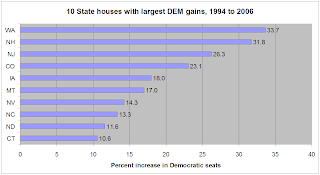 (click to enlarge images, via 538.com)
TW: The above show the movement for the Dems and Republicans by state since the 1994 "Gingrich" election. As we have posited previously the Republicans have become increasingly southern while the Dems have consolidated the northeast whilst growing their base in the mountain states. North Carolina being an exception which has gotten bluer as well.
The tricky part for the Dems is those southern Republican numbers will likely not change too much soon, their base is solid and getting even more conservative. Over time demographics especially related to Hispanics may have a significant impact making some of those states less red .
The Dem inroads in the mountain states and places like NC are precarious and vulnerable to the particularities of current events at the time of the next election. Converting folks disenchanted with W. Bush, Iraq etc. into actual progressive Dems will take some significant work.
Tuesday, July 21, 2009
Good News For Progressives
TW: 538.com did an interview with Democratic pollster Ruy Texiera, who put some meat on the bones of why the Dems are doing well electorally. We have posted on this before, our demographics both ethnically, culturally and age wise are moving towards the Dems.
The Republicans will have to broaden their base if they wish to build a new coalition. The old Reagan coalition (just like the old FDR coalition did) is aging and shrinking into obsolescence. People change, parties must as well.
From 538.com:
"...between 1988 and 2008, the minority share of voters in presidential elections has risen by 11 percentage points, while the share of increasingly progressive white college graduate voters has risen by 4 points. But the share of white working class voters, who have remained conservative in their orientation, has plummeted by 15 points. Want to know why McCain’s strategy failed in Pennsylvania? Same story: white working class voters declined by 25 points between 1988 and 2008, while white college graduates rose by 16 points and minorities by 8 points. Or in Nevada: white working class voters are down 24 points over the time period, while minority voters are up an amazing 19 points and white college graduates by 4 points.
More generally, progressives are doing very well among almost all growing demographic groups, while conservatives are retaining strength only where the country is stagnating or declining. One of the more dramatic manifestations of this pattern is the rise of the Millennial generation (those born 1978-2000). Millennial adults voted for Obama by a 34-point margin, 66 percent to 32 percent, compared to a 9-point margin for Kerry among 18- to 29-year-olds in 2004 when that age group was not exclusively Millennials. Between now and 2018, the number of Millennials of voting age will increase by about four and a half million a year, and Millennial eligible voters will increase by about 4 million a year. In 2020—the first presidential election where all Millennials will have reached voting age—this generation will be 103 million strong, of which about 90 million will be eligible voters. Those 90 million Millennial eligible voters will represent just under 40 percent of America’s eligible voters..."
The Republicans will have to broaden their base if they wish to build a new coalition. The old Reagan coalition (just like the old FDR coalition did) is aging and shrinking into obsolescence. People change, parties must as well.
From 538.com:
"...between 1988 and 2008, the minority share of voters in presidential elections has risen by 11 percentage points, while the share of increasingly progressive white college graduate voters has risen by 4 points. But the share of white working class voters, who have remained conservative in their orientation, has plummeted by 15 points. Want to know why McCain’s strategy failed in Pennsylvania? Same story: white working class voters declined by 25 points between 1988 and 2008, while white college graduates rose by 16 points and minorities by 8 points. Or in Nevada: white working class voters are down 24 points over the time period, while minority voters are up an amazing 19 points and white college graduates by 4 points.
More generally, progressives are doing very well among almost all growing demographic groups, while conservatives are retaining strength only where the country is stagnating or declining. One of the more dramatic manifestations of this pattern is the rise of the Millennial generation (those born 1978-2000). Millennial adults voted for Obama by a 34-point margin, 66 percent to 32 percent, compared to a 9-point margin for Kerry among 18- to 29-year-olds in 2004 when that age group was not exclusively Millennials. Between now and 2018, the number of Millennials of voting age will increase by about four and a half million a year, and Millennial eligible voters will increase by about 4 million a year. In 2020—the first presidential election where all Millennials will have reached voting age—this generation will be 103 million strong, of which about 90 million will be eligible voters. Those 90 million Millennial eligible voters will represent just under 40 percent of America’s eligible voters..."
Sunday, June 7, 2009
Tax Drunk Driving Not Drinking?
TW: Silver takes a different angle on taxing drinking. There is much buzz about raising alcohol taxes yet again. When revenues are short sin taxes are always a favorite. Silver though suggests targeting the taxes to the bad outcome of drinking rather than the drinking itself. He proposes stiff fines/taxes on drunk driving. An $8K per occurrence fine would raise as much money as an increase in the overall alcohol tax.
This will never happen because our systems are not set-up for such innovation. Plus some folks like sin taxes because they literally like taxing "sins". But I like the concept.
From Nate Silver at 538.com:
"There's pretty good economic evidence to suggest that alcohol consumption is fairly sensitive to price. And there's lots of good economic (and commonsencial) evidence that alcohol consumption is associated with a wide array of undesirable outcomes, from increased highway fatalities, to decreased productivity at work, to increased violence against women, to worsened health outcomes. Increasing alcohol taxes would, therefore, almost certainly save lives.
One problem, however, which is somewhat unique to liquor consumption, is that these behaviors aren't particularly strongly associated with drinking unto itself. They are associated, rather, with drinking to excess and/or engaging in other, particularly stupid sorts of behaviors while doing so. I know the evidence on this is mixed, but many studies have suggested that moderate alcohol consumption is in fact associated with improved health outcomes -- especially if you're drinking red wine and especially if you're a guy. A person who has a couple of drinks a couple of days a week, and who never drives or has the compulsion to engage in violence while doing so, imposes virtually no negative consequences either on himself or on society. Drinking doesn't cause negative externalities in the same way that, say, driving (traffic congestion and pollution) or smoking (second-hand smoke) intrinsically do.
People say it's difficult to tax the undesirable behaviors associated with drinking without taxing drinking itself. But is that necessarily so?
In 2006, there were 1.1 million arrests for drunk driving in the United States (source), not counting Florida which didn't report its statistics. Fine each of those people $8,000, and you'd have almost about $9 billion more to pay for health care every year. Why $8,000? Because that's the figure, according to a 2001 paper (.pdf) by Steve Levitt (the Freakonomics guy) and Jack Porter, that would be required to internalize the negative externalities associated with driving drunk.* By the way, if you're concerned that this tax might be regressive, you could scale it according to a person's income, as they do for traffic fines in Finland.
Of course, if you were actually to fine people $8K every time they got a drunk driving conviction, you wouldn't raise quite as much as $9 billion. Faced with a choice between an $8,000 fine or a $20 taxi fare, a lot more people would have Yellow Cab on speed dial, and you'd have fewer revenue-producing arrests.** But this is a feature of the policy rather than a bug -- you'd be stopping drunk driving. Moreover, it's exactly the same feature/bug problem you'd run into by raising alcohol taxes in general, or any time you were trying to use tax policy to disincentivize an undesirable behavior.
...But a drunk driver tax would be fairer, more efficient, and more Pigovian than a beer tax -- and good luck to the liquor industry in trying to oppose it"
http://www.fivethirtyeight.com/2009/06/liberal-blogger-matt-yglesias-wants-to.html
This will never happen because our systems are not set-up for such innovation. Plus some folks like sin taxes because they literally like taxing "sins". But I like the concept.
From Nate Silver at 538.com:
"There's pretty good economic evidence to suggest that alcohol consumption is fairly sensitive to price. And there's lots of good economic (and commonsencial) evidence that alcohol consumption is associated with a wide array of undesirable outcomes, from increased highway fatalities, to decreased productivity at work, to increased violence against women, to worsened health outcomes. Increasing alcohol taxes would, therefore, almost certainly save lives.
One problem, however, which is somewhat unique to liquor consumption, is that these behaviors aren't particularly strongly associated with drinking unto itself. They are associated, rather, with drinking to excess and/or engaging in other, particularly stupid sorts of behaviors while doing so. I know the evidence on this is mixed, but many studies have suggested that moderate alcohol consumption is in fact associated with improved health outcomes -- especially if you're drinking red wine and especially if you're a guy. A person who has a couple of drinks a couple of days a week, and who never drives or has the compulsion to engage in violence while doing so, imposes virtually no negative consequences either on himself or on society. Drinking doesn't cause negative externalities in the same way that, say, driving (traffic congestion and pollution) or smoking (second-hand smoke) intrinsically do.
People say it's difficult to tax the undesirable behaviors associated with drinking without taxing drinking itself. But is that necessarily so?
In 2006, there were 1.1 million arrests for drunk driving in the United States (source), not counting Florida which didn't report its statistics. Fine each of those people $8,000, and you'd have almost about $9 billion more to pay for health care every year. Why $8,000? Because that's the figure, according to a 2001 paper (.pdf) by Steve Levitt (the Freakonomics guy) and Jack Porter, that would be required to internalize the negative externalities associated with driving drunk.* By the way, if you're concerned that this tax might be regressive, you could scale it according to a person's income, as they do for traffic fines in Finland.
Of course, if you were actually to fine people $8K every time they got a drunk driving conviction, you wouldn't raise quite as much as $9 billion. Faced with a choice between an $8,000 fine or a $20 taxi fare, a lot more people would have Yellow Cab on speed dial, and you'd have fewer revenue-producing arrests.** But this is a feature of the policy rather than a bug -- you'd be stopping drunk driving. Moreover, it's exactly the same feature/bug problem you'd run into by raising alcohol taxes in general, or any time you were trying to use tax policy to disincentivize an undesirable behavior.
...But a drunk driver tax would be fairer, more efficient, and more Pigovian than a beer tax -- and good luck to the liquor industry in trying to oppose it"
http://www.fivethirtyeight.com/2009/06/liberal-blogger-matt-yglesias-wants-to.html
Saturday, May 2, 2009
More Nate Silver Perspective
TW: One of the Economist's blogs are started a weekly Q&A with a prominent person in politics, so far I like their dialogues. This week they speak with one of our favorites, Nate Silver from 538.com. A couple of insights but I especially liked his final comment, which should hold for him and all others who opine.
From Economist blog (Democracy in America aka DIA):
"...DIA: Since you were able to predict so many 2008 races months ahead of time based on immutable factors, how much do political campaigns really matter?
Mr Silver: There are two separate questions here: how much campaigns matter and how much candidates matter. Candidates clearly do matter, in the sense that it's not uncommon to get results in individual races that significantly diverge from the national trends. For instance, right now we have two Republican senators in Maine, which voted for Barack Obama by 18 points, and two Democratic senators in North Dakota, which hasn't voted a Democrat for President since 1964. Likewise, we have a Republican governor in Vermont and a Democratic governor in Kansas. When you see gravity-defying results like those, it usually boils down to a very talented candidate.
But how much do campaigns matter? They clearly matter some. Hillary Clinton, who proved to be a much stronger candidate than I expected but ran a very poor campaign, is probably Exhibit A in this regard. On the other hand, John McCain’s campaign basically went bankrupt during the Republican primaries and he managed to win the nomination.
...DIA: Despite all of the focus on Pennsylvania in the last days of the 2008 presidential campaign, it fell so easily to Barack Obama that people asked why it was even considered a "swing state". What, in your mind, are the swing states to watch in 2012? (Which blue state is most obtainable for Republicans? Which red state for Democrats?)
Mr Silver: Generally speaking, the same states that were swing states in 2008. But I would keep an eye on Georgia for the Democrats, which is rapidly beginning to urbanise and is becoming part of the "New South". For the Republicans—maybe New Jersey? One would expect that their anti-tax message would play well among wealthy voters, and there are a lot of wealthy voters in Jersey.
The other thing to watch is whether Barack Obama performs better in some parts of Appalachia, where I think his race hurt him in 2008. It wouldn’t surprise me if, after watching him on television for four years, some voters who had previously harboured some degree of racial animus begin to feel more comfortable with him. If so, Mr Obama could be more competitive in states like West Virginia.
DIA: You wrote that the McCain campaign "radically overestimated the importance of appealing to the base" in 2008. What type of political message would best serve Republicans trying to form a winning electoral coalition in 2010, 2012 and beyond.
Mr Silver: Well, that’s the $64,000 question. Clearly if the economy has not recovered, the Republicans will have the script somewhat written for them, and they can rail against the expansion of government or deficits or taxes or what have you. But I think they'll have to do it in an affirmative, pragmatic way—the "party of no" critique is a little hackneyed, but is probably fairly effective counter-messaging. And if the economy recovers? I don’t think it matters much what they do.
If they’re spending a lot of time talking about gay marriage, by the way, I think that's a sign that they're in trouble—unless perhaps the Supreme Court has ruled on it, which could reset the whole debate.
DIA: I've heard you say that baseball analysts put too much emphasis on what just happened. Is the same true of political analysts?
Mr Silver: For sure. And in baseball, at least, they're playing every year, whereas you only have a presidential election once every four years. The McCain campaign operated under the assumption that the political world hadn't changed since 2004—that Mr Obama couldn't turn out black voters or young voters, that swift-boating would work, that Mr Obama couldn't possibly win states like North Carolina and Indiana—and they paid a price for it. On the other hand, I think some Democrats might be a little bit complacent right now. There are a lot of things that can go wrong—both known unknowns and unknown unknowns. What if Afghanistan turns into the next Iraq? What if swine flu winds up killing several hundred thousand Americans? What if there's a nuclear exchange in Kashmir? What if there's a significant, unpredicted increase in the crime rate? Some of those things might hurt the Democrats and others might not, but there's a pretty decent chance that the core issues in 2012 will be things that we haven't even thought about yet.
DIA: You reach some surprising conclusions using your statistical techniques. How good is your average reader's understanding of your work? Do people ever say, "I don't care about your fancy 'mathematical' methods, that can't be right so you must be doing something wrong."
Mr Silver: More often I get the opposite—people who tell me they don’t really follow the analysis, but trust my conclusion. That's more worrying in some ways, I think...."
http://www.economist.com/blogs/democracyinamerica/2009/05/seven_questions_for_nate_silve.cfm
From Economist blog (Democracy in America aka DIA):
"...DIA: Since you were able to predict so many 2008 races months ahead of time based on immutable factors, how much do political campaigns really matter?
Mr Silver: There are two separate questions here: how much campaigns matter and how much candidates matter. Candidates clearly do matter, in the sense that it's not uncommon to get results in individual races that significantly diverge from the national trends. For instance, right now we have two Republican senators in Maine, which voted for Barack Obama by 18 points, and two Democratic senators in North Dakota, which hasn't voted a Democrat for President since 1964. Likewise, we have a Republican governor in Vermont and a Democratic governor in Kansas. When you see gravity-defying results like those, it usually boils down to a very talented candidate.
But how much do campaigns matter? They clearly matter some. Hillary Clinton, who proved to be a much stronger candidate than I expected but ran a very poor campaign, is probably Exhibit A in this regard. On the other hand, John McCain’s campaign basically went bankrupt during the Republican primaries and he managed to win the nomination.
...DIA: Despite all of the focus on Pennsylvania in the last days of the 2008 presidential campaign, it fell so easily to Barack Obama that people asked why it was even considered a "swing state". What, in your mind, are the swing states to watch in 2012? (Which blue state is most obtainable for Republicans? Which red state for Democrats?)
Mr Silver: Generally speaking, the same states that were swing states in 2008. But I would keep an eye on Georgia for the Democrats, which is rapidly beginning to urbanise and is becoming part of the "New South". For the Republicans—maybe New Jersey? One would expect that their anti-tax message would play well among wealthy voters, and there are a lot of wealthy voters in Jersey.
The other thing to watch is whether Barack Obama performs better in some parts of Appalachia, where I think his race hurt him in 2008. It wouldn’t surprise me if, after watching him on television for four years, some voters who had previously harboured some degree of racial animus begin to feel more comfortable with him. If so, Mr Obama could be more competitive in states like West Virginia.
DIA: You wrote that the McCain campaign "radically overestimated the importance of appealing to the base" in 2008. What type of political message would best serve Republicans trying to form a winning electoral coalition in 2010, 2012 and beyond.
Mr Silver: Well, that’s the $64,000 question. Clearly if the economy has not recovered, the Republicans will have the script somewhat written for them, and they can rail against the expansion of government or deficits or taxes or what have you. But I think they'll have to do it in an affirmative, pragmatic way—the "party of no" critique is a little hackneyed, but is probably fairly effective counter-messaging. And if the economy recovers? I don’t think it matters much what they do.
If they’re spending a lot of time talking about gay marriage, by the way, I think that's a sign that they're in trouble—unless perhaps the Supreme Court has ruled on it, which could reset the whole debate.
DIA: I've heard you say that baseball analysts put too much emphasis on what just happened. Is the same true of political analysts?
Mr Silver: For sure. And in baseball, at least, they're playing every year, whereas you only have a presidential election once every four years. The McCain campaign operated under the assumption that the political world hadn't changed since 2004—that Mr Obama couldn't turn out black voters or young voters, that swift-boating would work, that Mr Obama couldn't possibly win states like North Carolina and Indiana—and they paid a price for it. On the other hand, I think some Democrats might be a little bit complacent right now. There are a lot of things that can go wrong—both known unknowns and unknown unknowns. What if Afghanistan turns into the next Iraq? What if swine flu winds up killing several hundred thousand Americans? What if there's a nuclear exchange in Kashmir? What if there's a significant, unpredicted increase in the crime rate? Some of those things might hurt the Democrats and others might not, but there's a pretty decent chance that the core issues in 2012 will be things that we haven't even thought about yet.
DIA: You reach some surprising conclusions using your statistical techniques. How good is your average reader's understanding of your work? Do people ever say, "I don't care about your fancy 'mathematical' methods, that can't be right so you must be doing something wrong."
Mr Silver: More often I get the opposite—people who tell me they don’t really follow the analysis, but trust my conclusion. That's more worrying in some ways, I think...."
http://www.economist.com/blogs/democracyinamerica/2009/05/seven_questions_for_nate_silve.cfm
Thursday, April 16, 2009
This Bulge Explains Much
 TW: Nate Silver hits on a good point regarding why drug legalization is creeping back towards respectability. The baby boomers and those since were much heavier users (or at least experimenters) with pot than those who came before them. As the user demographic crowds out the older voters, pot becomes less exotic and perhaps less threatening.
Joe Klein put together a recent piece on legalization. We have hit many of the points previously but he reiterates some of the numbers and angles. Pot legalization goes to numerous challenges facing the U.S.- need for tax revenue, desire to reduce imports and grow domestic industry, need to reduce the stress at the Mexican border, need to address our ineffectively bulging prisons, and ultimately the need to address whether pot, alcohol and tobacco should be treated so differently.
From Joe Klein at Time:
"...the U.S. is, by far, the most "criminal" country in the world, with 5% of the world's population and 25% of its prisoners. We spend $68 billion per year on corrections, and one-third of those being corrected are serving time for nonviolent drug crimes. We spend about $150 billion on policing and courts, and 47.5% of all arrests are marijuana-related.
...It is estimated that pot is the largest cash crop in California, with annual revenues approaching $14 billion. A 10% pot tax would yield $1.4 billion in California alone. And that's probably a fraction of the revenues that would be available — and of the economic impact, with thousands of new jobs in agriculture, packaging, marketing and advertising.
So why not do it? There are serious moral arguments, both secular and religious. There are those who believe — with some good reason — that the accretion of legalized vices is debilitating, that we are a less virtuous society since gambling spilled out from Las Vegas to "riverboats" and state lotteries across the country. There is a medical argument, though not a very convincing one: alcohol is more dangerous in a variety of ways, including the tendency of some drunks to get violent. One could argue that the abuse of McDonald's has a greater potential health-care cost than the abuse of marijuana. (Although it's true that with legalization, those two might not be unrelated.) Obviously, marijuana can be abused. But the costs of criminalization have proved to be enormous, perhaps unsustainable. Would legalization be any worse?.."
http://www.time.com/time/nation/article/0,8599,1889021,00.html
Tuesday, April 14, 2009
The Spread Of Gay Marriage
 TW: As usual Nate Silver comes up with some insight. He projects the pace by which gay marriage will be approved nationally state by state. As I mentioned previously no other cultural right has evolved faster in my lifetime than gay rights. Not fast enough for some for some of our friends, far too fast for some others but fast nevertheless. Silver builds his model on three fairly straightforward metrics and determined other variables are essentially extraneous. The tipping point has probably been reached on this issue, conservatives should look elsewhere for a wedge.
From Nate Silver at 538.com:
"It turns out that you can build a very effective model by including just three variables:
1. The year in which the amendment was voted upon
2. The percentage of adults in 2008 Gallup tracking surveys who said that religion was an important part of their daily lives
3. The percentage of white evangelicals in the state.
...All of the other variables that I looked at -- race, education levels, party registration, etc. -- either did not appear to matter at all, or became redundant once we accounted for religiosity. Nor does it appear to make a significant difference whether the ban affected marriage only, or both marriage and civil unions..."
http://www.fivethirtyeight.com/2009/04/will-iowans-uphold-gay-marriage.html
Thursday, April 2, 2009
All You Need To Know About GM
 TW: Nate Silver nails GM. Any company or industry (I would think Ford/Chrysler have similar charts), with a similar chart would be doomed. Anyone who invested in a U.S. automaker over the past 40 years (other than a trader playing the movement around the general decline) was on a fool's errand. Why does the chart look this way? Two things, massive competition from the internationals and retirement benefit deals made decades ago which larded the present day company with unsustainable burdens.
 If this concept was merely limited to the U.S. automakers it would be bad enough. Unfortunately the automakers in many respects are metaphorical for the overall U.S. fiscal system. Workers have been promised retirement benefits which are also unsustainable. Folks have taken out mortgages for which they will be unable to support. Banks have made unsustainable loans etc., etc. The common thread short-term gain for long-term pain.
Our states are creating pension time bombs that will make the automakers seem tame. The housing bubble at least is bursting in rapid if too spectacular a form. Benefits (health care/pensions etc.) must come down!!
From Silver at 538.com:
"...The auto business is highly cyclical because consumers are buying expensive assets that last for years at a time. Nobody ever really has to buy a new car (they can buy a used one if their car breaks down), and therefore consumers are willing to hold on to their existing vehicles and wait out economic slumps. You can't do that with, say, a loaf of bread, or even something like a cellphone, which has a much shorter lifespan.
...If I were an alien beaming down from Rigel-3 looking at this pattern -- an alien with an MBA degree -- my first guess is that it would reflect some sort of systemic problem, some chronic imbalance that magnified over time. Something, in other words, like the costs of GM's retiree pension and health care programs. It's difficult to get a precise figure on these so-called legacy costs, but they averaged about $7 billion per year between 1993 and 2007 and are probably at least $10 billion per year now. Considering that GM has never made as much as $10 billion in profit in a year and that its entire operating lossses in 2008 were $13.8 billion, you can see why this is a significant problem.
...Of course, GM benefited by promising its employees access to lucrative retirement programs -- it benefited by being able to pay less to those employees in the form of salary. But whereas the benefits to GM came long ago, the costs come now...GM was willing to cut its employees some very attractive deals in the 1950s through the 1980s -- provided that they took them in the form of retirement benefits rather than salary
...This issue is wrongly portrayed by both the liberal and the conservative media as one of management versus labor, when really it is a battle between General Motors past and General Motors present. In the 50s, 60s and 70s, everyone benefited: GM and its shareholders got the benefit of higher profit margins, and meanwhile, its employees benefited from GM's willingness to cut a bad deal -- for every dollar they were giving up in salary, those employees were getting a dollar and change back in retirement benefits. But now, everyone is hurting.
...most of the excess costs it requires to produce a Buick versus a Toyota come in the form of legacy costs, not what those employees are receiving in salary and benefits today. And the taxpayer is bound to to get screwed either way, either picking up the tab to bail out GM, or bearing the costs of the pension programs, which are guaranteed by the government (although the legacy health benefits aren't guaranteed)..."
Wednesday, March 11, 2009
More On Obama +50 Days
 TW: Obama is receiving probably a record amount of scrutiny at the 50 day mark of his presidency. But then it does feel like it has been much longer and has been since W. Bush basically ceded substantive power on Nov 5th if not earlier. And as Silver points out, most POTUS do not enter office amidst a depressionary economy (not to mention a couple of hot wars).
Tables like above provide ammo for all points of view, he is no more popular than most or more popular than most depending on your bias. But net net I go with Nate Silver's comments.
From Nate Silver at 538:
"...This is not to say that everything has been foolproof. Far from it. The administration, I'm guessing, if it had to do it over again, would not have taken two weeks off and tried to let Nancy Pelosi sell the stimulus. It would not have overpromised on what Tim Geithner was going to be able to deliver, and it would have looked up Zoë Baird's name on Wikipedia and recognized that there are certain bugaboos when it comes to cabinet nominations that it isn't worth fighting uphill against.But for me -- and yes, I know, I drunk the kool-aid a long time ago -- there's still nobody that I'd rather have in office right now. A large fraction of the country evidently feels the same way."
Friday, February 13, 2009
The Bank Morass and Geithner
TW: I do not post on the details of the banking morass as there is cacophony of voices trying generally unsuccessfully to provide some level of insight. The problem as Silver outlines is that few are actually qualified to speak intelligently to the topic and if they are the details are intricate unless one devolves into ideology (a frequent occurrence).
Bitching about the proposals out of the government is the easy route, that was true with Paulson and it is true with Geithner. But again as Silver points out, if anyone has an incentive to get this thing right it is the Obama Administration. Those on the left squawking about a sellout to Wall Street are from my perspective deeply wrong.
I sense that our financial system is screwed (specifically not only insolvent but deeply so). I do not know the answer. I suspect nationalization may be the ultimate direction as the losses are enormous (measured in trillions). One way or the other the governments here and elsewhere will have to absorb massive losses created by our financial institutions and their customers. While this is highly annoying and frustrating, I have yet to read a viable alternative solution. For those repulsed by the concept of nationalization I simply ask what is your solution especially one that is not merely socializing all the losses while in form avoiding nationalization.
From Nate Silver:
"...I'm sorry, but somewhere between 99.9% and 99.999999% of us are severely underqualified to be making policy recommendations on this particular issue. And I'm certainly in the majority on this one. My anecdotal experience for the past several months has been that the more someone knows about the economy, the more they know (or at least are willing to admit to) what they don't know. Anyone who is professing with certainty that this or that will work -- nationalizing the banks, for instance -- is an idiot.
...Nobody, absolutely nobody, has more incentive to get this right than the Obama Administration. If the economy collapses -- well, more than it already has collapsed -- then the Democrats get slaughtered in 2010, Obama is a one-termer, health care doesn't happen, the poverty rate increases by a couple orders of magnitude, and the imperative to fix the environment gets put on the backburner. To suggest that Obama or Geithner are tools of Wall Street and are looking out for something other than the country's best interest is freaking asinine. Maybe their ideas are wrong -- but their hearts are in the right place."
http://www.fivethirtyeight.com/2009/02/give-geithner-break.html
Bitching about the proposals out of the government is the easy route, that was true with Paulson and it is true with Geithner. But again as Silver points out, if anyone has an incentive to get this thing right it is the Obama Administration. Those on the left squawking about a sellout to Wall Street are from my perspective deeply wrong.
I sense that our financial system is screwed (specifically not only insolvent but deeply so). I do not know the answer. I suspect nationalization may be the ultimate direction as the losses are enormous (measured in trillions). One way or the other the governments here and elsewhere will have to absorb massive losses created by our financial institutions and their customers. While this is highly annoying and frustrating, I have yet to read a viable alternative solution. For those repulsed by the concept of nationalization I simply ask what is your solution especially one that is not merely socializing all the losses while in form avoiding nationalization.
From Nate Silver:
"...I'm sorry, but somewhere between 99.9% and 99.999999% of us are severely underqualified to be making policy recommendations on this particular issue. And I'm certainly in the majority on this one. My anecdotal experience for the past several months has been that the more someone knows about the economy, the more they know (or at least are willing to admit to) what they don't know. Anyone who is professing with certainty that this or that will work -- nationalizing the banks, for instance -- is an idiot.
...Nobody, absolutely nobody, has more incentive to get this right than the Obama Administration. If the economy collapses -- well, more than it already has collapsed -- then the Democrats get slaughtered in 2010, Obama is a one-termer, health care doesn't happen, the poverty rate increases by a couple orders of magnitude, and the imperative to fix the environment gets put on the backburner. To suggest that Obama or Geithner are tools of Wall Street and are looking out for something other than the country's best interest is freaking asinine. Maybe their ideas are wrong -- but their hearts are in the right place."
http://www.fivethirtyeight.com/2009/02/give-geithner-break.html
Monday, February 9, 2009
Learning From the Politics Of Stimulation
TW: Nate Silver is back at it with some good analysis of the politics surrounding the stimulus package. I would especially focus on #2. I actually think Pelosi is a good Speaker but I know many of my friends do not agree. Reid is in substance a tough character but his persona reeks of fecklessness. Net net, Obama could have done much worse but certainly much better as well, as with many things in life it is all about the learning curve. I suspect he will move up the curve quite rapidly.
From Nate Silver at 538.com:
"1. Republicans have nothing to lose. Public perceptions of Congressional Republicans are also significantly down from their already-low levels since the stimulus debate began. But, the Republicans will gladly torpedo their own brand if it means taking Obama down with them. They are dangerous to him, in the way that a gang of rabid velociraptors is dangerous to a T-Rex.
2. Obama has to do the heavy lifting himself. Support for the stimulus dwindled when the Congressional Demorcats, who are not much more popular than their Republican colleagues, were charged with the job of selling it. The more Nancy Pelosi and Harry Reid are the faces of the Democratic Party, the more Barack Obama's approval ratings will come to resemble those of Nancy Pelosi and Harry Reid.
3. The benefits of "bipartisanship" are dubious. The public says they want bipartisanship, and a large majority of the public believes that Obama acted in a bipartisan fashion during the stimulus debate. And yet, his approval ratings fell significantly during this period.There are, obviously, a lot of factors to keep in balance here, but more than anything else the public seems to be seeking strong leadership from Obama; they don't want him to be deferential to either Congressional Democrats or Congressional Republicans."
From Nate Silver at 538.com:
"1. Republicans have nothing to lose. Public perceptions of Congressional Republicans are also significantly down from their already-low levels since the stimulus debate began. But, the Republicans will gladly torpedo their own brand if it means taking Obama down with them. They are dangerous to him, in the way that a gang of rabid velociraptors is dangerous to a T-Rex.
2. Obama has to do the heavy lifting himself. Support for the stimulus dwindled when the Congressional Demorcats, who are not much more popular than their Republican colleagues, were charged with the job of selling it. The more Nancy Pelosi and Harry Reid are the faces of the Democratic Party, the more Barack Obama's approval ratings will come to resemble those of Nancy Pelosi and Harry Reid.
3. The benefits of "bipartisanship" are dubious. The public says they want bipartisanship, and a large majority of the public believes that Obama acted in a bipartisan fashion during the stimulus debate. And yet, his approval ratings fell significantly during this period.There are, obviously, a lot of factors to keep in balance here, but more than anything else the public seems to be seeking strong leadership from Obama; they don't want him to be deferential to either Congressional Democrats or Congressional Republicans."
Sunday, February 1, 2009
Nice Move Naming Gregg But The End Game Will Be More Subtle Than Some Think
TW: Obama's apparently intention to appoint Republican Senator Judd Gregg from NH to the Commerce Secretary post has received much attention but for the wrong reason. I strongly doubt the Democratic Governor of NH will appoint a Dem to the seat giving the Dems cloture control in the Senate, that would be a bit blunt. I assume Gregg is asking Obama to commit to a Republican replacement as a condition for taking the Commerce slot (if not am sure he will claim so anyway).
Obama and the Dems can be more subtle by taking out Gregg a strong if vulnerable incumbent they can set up a more vulnerable replacement ripe for picking in '10 or even as Nate Silver suggests appoint a Rockefeller Republican (my party personal identification but that is for a different post) who might exhibit those RINO (Republican in name only) characteristics that drive folks like Rush Limbaugh crazy. A Rockefeller type Republican could vote with the Dems frequently while still giving the Dems the wiggle room of NOT having a cloture type majority. If the Dems achieve cloture majority then the Republicans can focus on obstruction like their House colleagues.
From 538.com:
"...If Gregg's replacement must be a Republican, there is one name that would allow Lynch to come as close as possible to splitting the difference between the parties. That name is that of former State Representative Liz Hager, who has admitted to her interest in the position. Hager is a Republican and says she would caucus with the Senate Republicans. Beyond that, however, there is a lot for Democrats to like. Hager, after being primaried out by more conservative opponents for her State House seat, endorsed Barack Obama, citing his pro-choice position. She is also a proud moderate.
...As the Republican party has gravitated toward conservatives, however, and as the Rockefeller Republicans have simultaneously been co-opted by New Democrats, they have become a dying breed, their vestige only apparent in a few remaining legislators like Sens. Susan Collins and Olympia Snowe of Maine. Hager, who has become an active critic of the Republican establishment, would probably legislate to Collins's and Snowe's left, and quite possibly to the left of several Senate Democrats
...Hager's appointment would furthermore deprive the Republicans the opportunity to claim that the Democrats had a filibuster-proof monopoly on power. And yet, at a time when their party is struggling to formulate anything resembling a majority coalition, they would seem to have little choice but to accept her, as her appointment would be the result of a Democratic President and Democratic Governor each having taken the unorthodox step of reaching across party lines to select a Republican. The Republicans could, of course, complain with ample justification that Hager was a RINO, but in so doing they would appear immoderate and intolerant at a time when the pretense of moderation and postpartisanship is the name of the game..."
http://www.fivethirtyeight.com/2009/01/for-democrats-best-choice-may-be.html
Obama and the Dems can be more subtle by taking out Gregg a strong if vulnerable incumbent they can set up a more vulnerable replacement ripe for picking in '10 or even as Nate Silver suggests appoint a Rockefeller Republican (my party personal identification but that is for a different post) who might exhibit those RINO (Republican in name only) characteristics that drive folks like Rush Limbaugh crazy. A Rockefeller type Republican could vote with the Dems frequently while still giving the Dems the wiggle room of NOT having a cloture type majority. If the Dems achieve cloture majority then the Republicans can focus on obstruction like their House colleagues.
From 538.com:
"...If Gregg's replacement must be a Republican, there is one name that would allow Lynch to come as close as possible to splitting the difference between the parties. That name is that of former State Representative Liz Hager, who has admitted to her interest in the position. Hager is a Republican and says she would caucus with the Senate Republicans. Beyond that, however, there is a lot for Democrats to like. Hager, after being primaried out by more conservative opponents for her State House seat, endorsed Barack Obama, citing his pro-choice position. She is also a proud moderate.
...As the Republican party has gravitated toward conservatives, however, and as the Rockefeller Republicans have simultaneously been co-opted by New Democrats, they have become a dying breed, their vestige only apparent in a few remaining legislators like Sens. Susan Collins and Olympia Snowe of Maine. Hager, who has become an active critic of the Republican establishment, would probably legislate to Collins's and Snowe's left, and quite possibly to the left of several Senate Democrats
...Hager's appointment would furthermore deprive the Republicans the opportunity to claim that the Democrats had a filibuster-proof monopoly on power. And yet, at a time when their party is struggling to formulate anything resembling a majority coalition, they would seem to have little choice but to accept her, as her appointment would be the result of a Democratic President and Democratic Governor each having taken the unorthodox step of reaching across party lines to select a Republican. The Republicans could, of course, complain with ample justification that Hager was a RINO, but in so doing they would appear immoderate and intolerant at a time when the pretense of moderation and postpartisanship is the name of the game..."
http://www.fivethirtyeight.com/2009/01/for-democrats-best-choice-may-be.html
Subscribe to:
Posts (Atom)